
 The Supreme Court term ended this past week with the announcement of several controversial decisions. Along with the end of the term came word that the court’s approval rating had hit an all-time low. To be sure, Americans are not supportive of many of the decisions being made by the court. But more importantly, they are not happy with the way the court is reaching those decisions, or how the justices are conducting themselves outside of court.
This is an important distinction. In recent months, Chief Justice John Roberts and a few of the associate Justices, have bemoaned the fact that the Court’s approval rating has plummeted, commenting that it is the Court’s job to make difficult decisions and that the public should not lose faith in the court simply because they don’t agree with the decisions. However, the Justices are smart enough to understand that it isn’t their decisions that are creating a legitimacy crisis for the court. It is the way those decisions are being reached, as well as revelations of serious ethical lapses by a handful of Justices who have used their positions on the Court to enrich themselves.
For instance, during this past term, the court ruled on one dispute where the respondents likely did not have standing to bring the case (Biden v Nebraska). In that case, involving student loan forgiveness promulgated by the Department of Education under the HEROES Act, the organizations that brought the original suit were not impacted by the Act and did not suffer any damages as a result of its pending implementation. Even so, the majority overlooked this fact and ruled on the case anyway, giving the appearance that that the majority felt the ends justified the means, even if that meant overlooking a crucial flaw in the case.
In another case, 303 Creative v Colorado, there was no actual dispute. The entire case was hypothetical and was based on a lie. The plaintiff, Lorie Smith, was a web developer who was considering adding wedding websites to her business’s offerings. Importantly, she had never actually created any wedding websites. She feared that if she expanded her business, she might be called on to make a website for a same-sex wedding, something she opposed. She claimed that she had received a request from a man who was potentially interested in having her design a website for him and his future husband. However, when journalists reached out to the man who allegedly sent the request, they found out that not only had he not sent it, but he was married to a woman and had been for 15 years. Again, the majority ignored the facts in order to reach a decision that corresponded with their deeply held political beliefs. As Justice Elena Kagan wrote in her dissent, not only was the case not ripe for adjudication by the court, but it was actually unconstitutional for the court to rule on it.
And in the affirmative action case of Students for Fair Admissions, Inc. v. President and Fellows of Harvard College, Justices in the majority were utterly intellectually dishonest in their opinion, justifying it with half-truths and inaccurate history. It wasn’t the decision that rubbed people the wrong way, although they certainly disagreed with it. It was more the dishonest way the Court reached the decision. To many observers, it was obvious that the majority’s decision was based on politics more than law.
In addition to the Justices’ tortured, partisan logic in these cases, revelations of unethical behavior by many of the justices has helped create the collapse of trust in the court. Pro Publica reported on Justice Clarence Thomas and Justice Samuel Alito, the Court’s two most extreme conservative justices, accepting private air travel, exotic yacht vacations, and expensive lodging at exclusive resorts from billionaires who had business before the Court.
In Thomas’ case, he also allowed his benefactor to pay for his grand-nephew’s private school tuition and purchase his mother’s home, while letting her live there rent-free, and then failing to report the gifts. In addition, far right political donor Leonard Leo funneled money to Thomas’ wife, Ginni, and went to great lengths to conceal the payments. Again, Thomas failed to disclose the money paid to his wife.
Justice Neil Gorsuch sold a piece of land he had been unable to sell for two years, to an attorney who routinely practiced before the court, just nine days after being sworn in as a Justice. Gorsuch failed to report the identity of the buyer on his government ethics disclosure form.
And the Chief Justice’s wife was paid more than $10 million to act as a recruiter for high-powered law firms that practice before the Court. While this behavior, as well as the behavior involving the other Justices may have been technically legal, it’s ethically questionable, and it most certainly creates the appearance of wrong-doing, especially when the Justice’s themselves fail to report it.
I have been observing the Court for several years. In fact, while studying for a master’s degree in political science, my emphasis was on the Supreme Court, particularly in efforts to reform it. I’ve never seen a Court that was so broken and which had so lost the trust of the American people. Polls conducted by Quinnipiac and Marquette University Law School confirm that the Court’s approval rating is lower now than at any time in the past.
There are lots of reasons for this sad fact. First, the way that the court was built, using highly unusual political maneuvering to prevent a Democratic President from appointing Justices and instead handing that privilege to a Republican President, make those appointments illegitimate in the eyes of a lot of Court observers’. The fact that the electorate as a whole has become more liberal at the same time the Court has become more conservative has also helped to damage the public’s perception of the Court.
The ethical problems experienced by several of the Justices is another reason that the Court’s legitimacy has been called into question. There has been one revelation after another of Justice’s using their position for personal gain.
And finally, the perception that the Court’s conservative wing has used the Court to implement their own political agenda, manipulating cases on the way to achieve that goal, has created a collapse of trust and a crisis of legitimacy for the Court, and by extension, for our nation. According to an ABC News poll conducted in early July 2023, 53% of respondents said they felt the Court was making decisions based on politics rather than the law. Think about that. Based on the poll, more than half of citizens feel the Court is following politics rather than the law when reaching decisions that impact the daily lives of millions of Americans. That is the epitome of a legitimacy crisis for the Court.
In order to save the Court, reforms are needed. Most people agree with this statement. What they don’t agree on is which reforms are needed or how those reforms should be implemented. Over the next several weeks, I’m going to take a look at proposed Court reforms, examine the arguments for and against those reforms, and give you my opinion on which ones, if any, should be implemented. As much as possible, I will keep politics out of the discussion. Instead, my focus will be on how, if at all, the proposed reform can rebuild trust in the Court and restore legitimacy to the institution and it’s decisions.
In the next post, I’ll look at how we got to this point. I want to make sure everyone understands how we ended up in our current predicament. In the weeks to follow, I’ll look at several proposed reforms that have been offered to fix the Court and restore it to a trusted, indispensable part of our federal government.



 I was in my fifties the first time I ate at a Waffle House. Until then, Waffle House, to me, was a place where addicts, the homeless, and the down-and-out ate. I know that doesn’t make sense. Heck, generally speaking, the homeless don’t normally eat their meals in restaurants. I don’t mean to besmirch anyone. I just didn’t think Waffle House restaurants were for me. Boy, was I wrong.


 The word “fascism” gets thrown around a lot these days. Often, when someone uses the word, they use it incorrectly. The truth is, most people don’t actually know what the word “fascism” means. They often use the word to describe someone or something they don’t like, but “fascism” has an actual definition. And in many cases, that definition is much different than what people think it is.
 I was probably fourteen or fifteen years old when I had my first taco. It was made with seasoned ground beef on an Old El Paso hard taco shell, garnished with onions and shredded cheese, then smothered in Old El Paso Taco Sauce. For the next several years, I was under the impression that the tacos my mother made for our family were the only kind of tacos in the world. I was naïve.
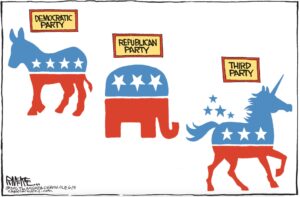 No Labels, the supposedly moderate, “get things done,” political organization, is gearing up to run a third-party candidate in the 2024 Presidential Election. They are currently fundraising, and are doing so by trying to convince people that not only can they win, but if they do, all of our current problems with political division and gridlock will magically disappear, ushering in a new era of cooperation and tri-partisanship. That’s nonsense. There’s no way any of that is going to happen.
 At only 5’2”, Ben Ferencz was not an imposing figure. But during the course of his life, he became a giant in the areas of international criminal law, in prosecuting war crimes, and in the quest for world peace. He died earlier this month (4/7/23) in an assisted living facility in Boynton Beach, FL. He was 103.


 It’s sad to say, but mass shootings in the United States have become so common, that it is easy to view them from a distance, to be detached. After all, the shootings happen somewhere else, to someone else. Sure, they’re horrible, but for most of us, they don’t really affect our lives. Until they do.